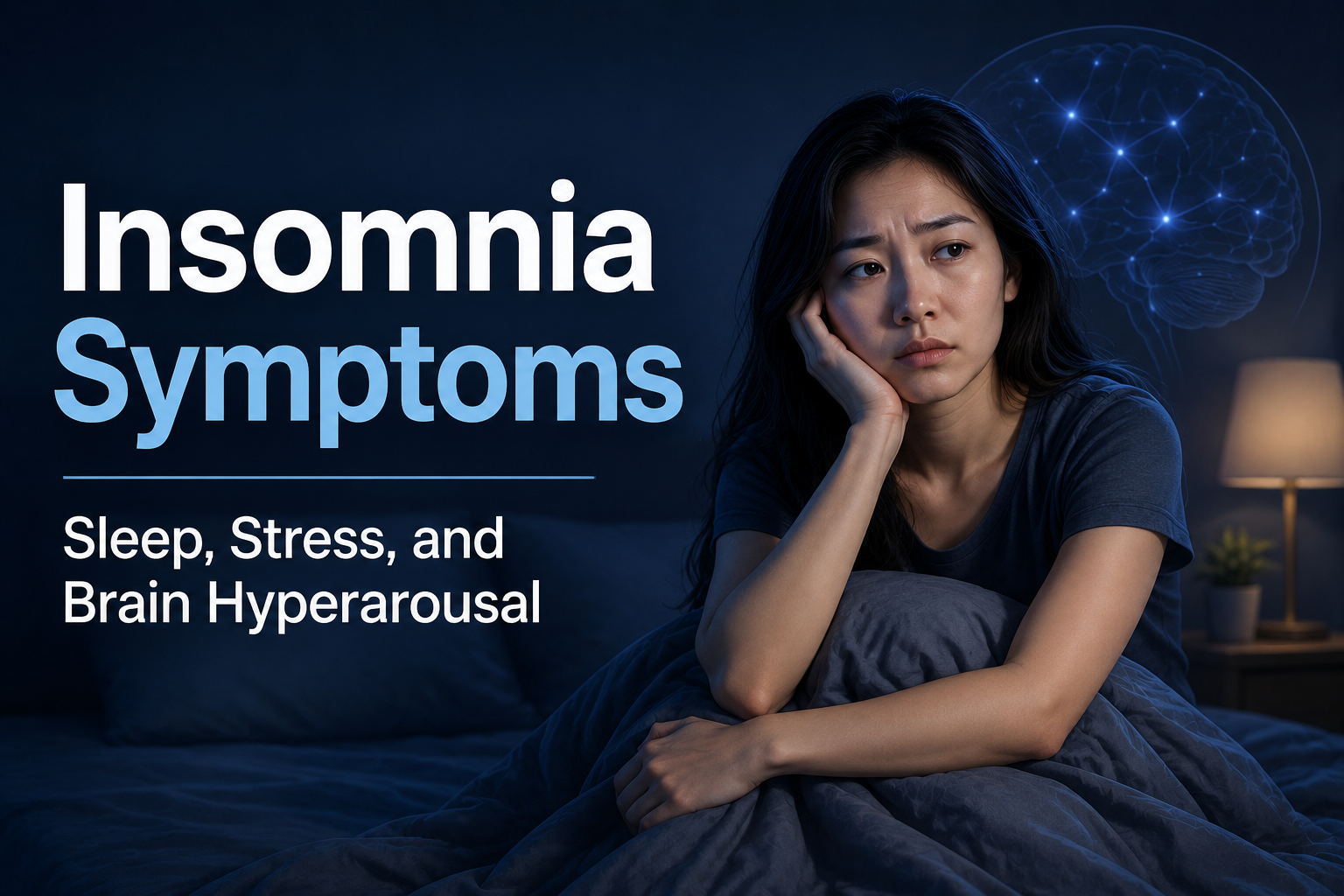
Overview of Insomnia Symptoms
Insomnia symptoms are clinical features of insomnia, a condition characterized by persistent difficulty initiating sleep, maintaining sleep, or achieving restorative sleep despite adequate opportunity for rest.
Insomnia symptoms include nighttime sleep disturbance and daytime impairment such as fatigue, poor concentration, irritability, and reduced emotional stability. Modern medicine explains insomnia as a disorder involving dysregulation of the sleep regulation system, autonomic nervous system imbalance, altered melatonin secretion, and excessive arousal. In Korean medicine, the condition is understood as a disturbance of the balance between qi, blood, yin, and yang, leading to instability of mental and physiological calmness during the sleep-wake cycle.
Korean Medicine Neuropsychiatry investigates how emotional stress, autonomic imbalance, and neurophysiological dysregulation interact with traditional concepts of mind-body imbalance. The Korean Society of Oriental Neuropsychiatry studies insomnia symptoms through integrated frameworks combining neuroscience, stress physiology, and Korean medicine theory.

Clinical Features of Insomnia Symptoms
Insomnia symptoms are described as disturbances involving sleep onset, sleep maintenance, early morning awakening, or non-restorative sleep. These symptoms are associated with impaired daytime functioning, including fatigue, poor concentration, irritability, reduced motivation, and emotional instability.
Difficulty falling asleep is one of the most common insomnia symptoms. It may be explained by excessive cognitive activity, stress-related tension, and heightened sympathetic nervous system activation. Individuals may report racing thoughts, sensitivity to sound or light, and anxiety about whether they will be able to sleep.
Sleep maintenance insomnia is associated with repeated nighttime awakenings and difficulty returning to sleep. Early morning awakening is often linked to mood dysregulation, chronic stress exposure, and disruption of circadian rhythm stability.
From a Korean medicine perspective, insomnia symptoms are understood as disturbances of shen stability and internal balance. Liver qi stagnation may be associated with emotional tension and difficulty relaxing, while heart blood deficiency and yin deficiency may contribute to light sleep, excessive dreaming, and nighttime restlessness.

Causes and Etiology of Insomnia Symptoms
Insomnia symptoms may be explained by complex interactions among stress response systems, neurobiological vulnerability, emotional dysregulation, and environmental influences. The sleep regulation system involves coordinated activity among the hypothalamus, brainstem, thalamus, pineal gland, and cerebral cortex.
Melatonin is considered to be an important hormone in circadian rhythm regulation and sleep initiation. Disrupted melatonin secretion is associated with delayed sleep onset, fragmented sleep, and impaired synchronization between the internal biological clock and external light-dark cues.
The hypothalamic-pituitary-adrenal axis is associated with stress hormone regulation. Chronic stress may increase cortisol secretion and sympathetic nervous system activity, producing a state of physiological hyperarousal that interferes with sleep initiation and maintenance.
Neurotransmitters such as GABA, serotonin, norepinephrine, and dopamine are associated with arousal regulation, emotional stability, and sleep architecture. Reduced inhibitory regulation and increased alerting signals may contribute to persistent insomnia symptoms.

Physiological Changes Related to Insomnia Symptoms
Insomnia symptoms are associated with autonomic nervous system imbalance, stress hormone dysregulation, immune changes, and altered cardiovascular responses. During healthy sleep, the body generally shifts toward parasympathetic dominance. In insomnia, sympathetic activity may remain elevated during the night.
This pattern may be expressed as increased heart rate, muscle tension, shallow breathing, heightened sensory sensitivity, and difficulty entering restorative sleep. Reduced parasympathetic recovery is considered to be one of the physiological features of chronic insomnia.
In Korean medicine, these changes are understood as reflecting excessive internal activation and insufficient restorative yin function. Yin deficiency may be linked to nighttime restlessness and internal heat sensations, while qi stagnation may be linked to emotional tension and autonomic dysregulation.

Korean Medicine Pathophysiology of Insomnia Symptoms
Liver Qi Stagnation
Liver qi stagnation is associated with emotional stress, frustration, and impaired relaxation. It may contribute to difficulty falling asleep, irritability, chest tightness, and frequent awakening. This concept may be connected with modern findings on stress-induced autonomic activation and limbic system hyperreactivity.
Yin Deficiency
Yin deficiency is understood as insufficient cooling, calming, and restorative function. It is associated with nighttime restlessness, dry mouth, internal heat sensations, and fragmented sleep. From a neuroscience perspective, this pattern may be explained by impaired parasympathetic recovery and sustained hyperarousal.
Blood Deficiency
Blood deficiency is considered to be related to insufficient nourishment of mental stability. It may be associated with light sleep, excessive dreaming, palpitations, fatigue, and poor concentration. These symptoms overlap with the daytime impairment commonly observed in insomnia symptoms.
Phlegm Accumulation
Phlegm accumulation is understood as a pathological state that may interfere with mental clarity and smooth physiological regulation. It is associated with mental fogginess, chest discomfort, anxiety, and unstable sleep. This may correspond to dysregulated stress signaling and impaired autonomic coordination.

Treatment Perspective for Insomnia Symptoms
From the perspective of Korean Medicine Neuropsychiatry, treatment is understood as a process of restoring autonomic balance, regulating emotional stability, and improving the physiological mechanisms that support restorative sleep.
Modern approaches to insomnia symptoms often focus on sleep hygiene, cognitive behavioral regulation, circadian rhythm stabilization, stress management, and appropriate medical care when needed. These approaches aim to reduce hyperarousal and restore stable sleep-wake regulation.
Korean medicine treatment perspectives focus on identifying the underlying pattern of imbalance. Liver qi stagnation may require regulation of emotional tension, yin deficiency may require restoration of calming and nourishing function, and blood deficiency may require support for mental and physical recovery.
Integrated care emphasizes that insomnia symptoms are not only nighttime problems but also reflections of broader nervous system dysregulation. Recovery is understood as the restoration of sleep rhythm, emotional regulation, autonomic flexibility, and daytime functional capacity.
For related information, see our article on panic disorder symptoms and stress-related autonomic nervous system imbalance.
General sleep health information is also discussed by the Sleep Foundation.
For broader public health information, visit the National Heart, Lung, and Blood Institute insomnia resource.

Summary of Insomnia Symptoms
Insomnia is a neuropsychiatric condition characterized by persistent difficulty with sleep initiation, sleep maintenance, or restorative sleep quality. Insomnia symptoms are associated with sleep regulation system disruption, melatonin rhythm alteration, autonomic nervous system imbalance, and chronic stress-related hyperarousal.
Modern medicine explains insomnia symptoms through interactions among circadian rhythm disruption, cortical hyperactivation, stress physiology, and neurotransmitter imbalance. In Korean medicine, insomnia is understood as a condition involving disharmony of qi, blood, yin, and emotional regulation systems.
Korean Medicine Neuropsychiatry studies how neural mechanisms, emotional stress, and autonomic regulation interact with Korean medicine concepts such as liver qi stagnation, yin deficiency, blood deficiency, and phlegm accumulation. The Korean Society of Oriental Neuropsychiatry investigates and integrates these academic frameworks to explain insomnia symptoms from both neuroscience and Korean medicine perspectives.