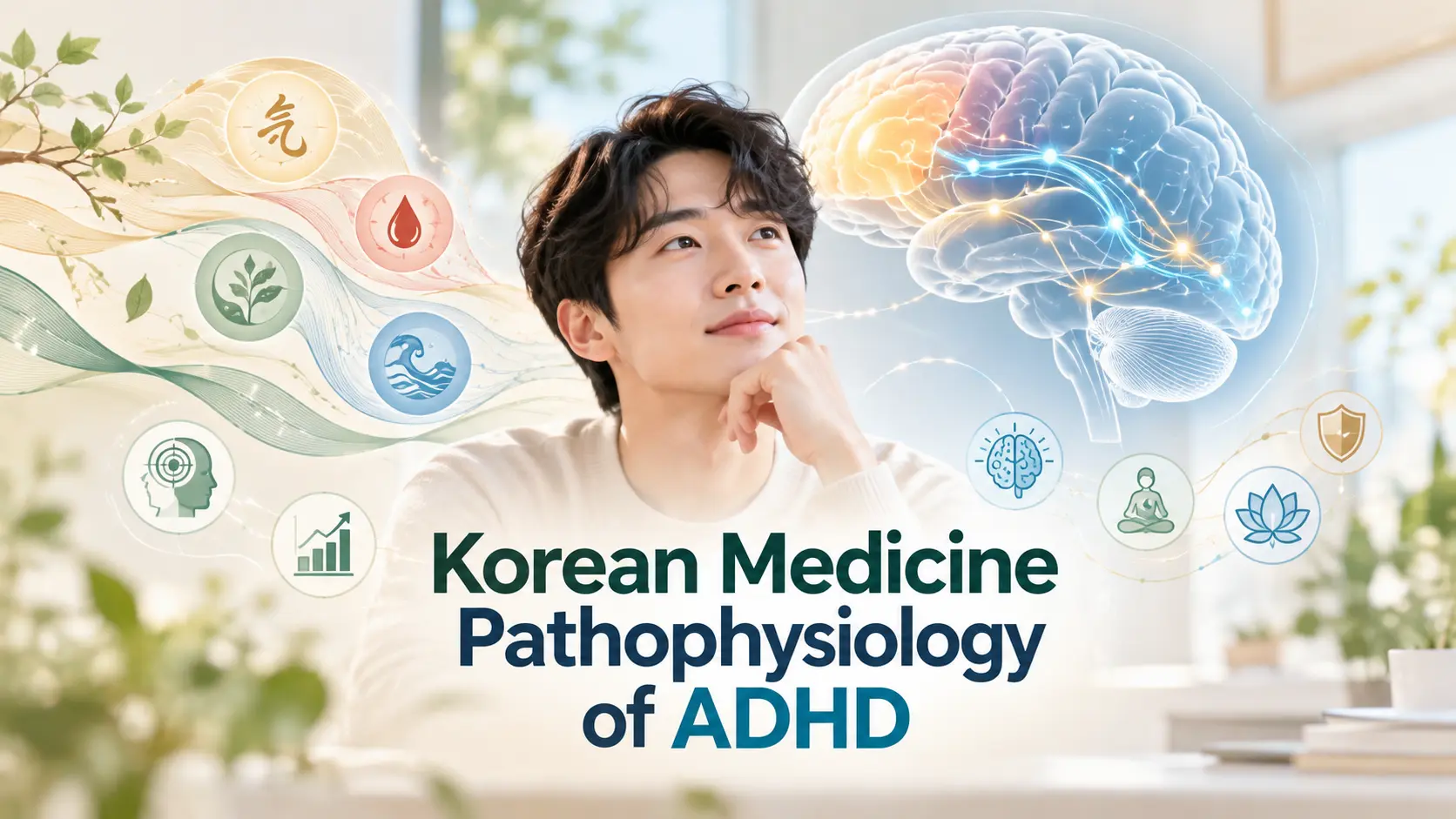
Attention-deficit/hyperactivity disorder (ADHD) is a neurodevelopmental condition characterized by persistent patterns of inattention, hyperactivity, and impulsivity that interfere with development or everyday functioning. ADHD Korean medicine pathology provides an additional framework for examining these clinical manifestations through functional disturbances involving qi, blood, yin, stress regulation, and mind-body interactions.
ADHD is described as a condition in which difficulties with attention regulation, inhibitory control, activity regulation, and executive function may persist across developmental stages. Modern neuroscience examines these difficulties through brain networks and neurotransmitter systems, while Korean Medicine Neuropsychiatry interprets the broader pattern of cognitive, emotional, autonomic, and physical changes that can accompany the disorder.
Overview
Modern medicine explains ADHD as a neurodevelopmental disorder associated with differences in the regulation of the prefrontal cortex, basal ganglia, striatum, and fronto-striatal circuits. These networks participate in executive function, working memory, response inhibition, motivation, attention allocation, and goal-directed behavior.
In Korean medicine, the condition is understood through functional patterns that may include qi-blood deficiency, yin deficiency, qi stagnation, and phlegm-related disturbance. ADHD Korean medicine pathology does not treat these traditional concepts as anatomical equivalents of neural structures. Instead, they provide a pattern-based language for organizing combinations of attention difficulties, restlessness, fatigue, emotional changes, sleep disturbance, and other systemic features.
The two perspectives therefore operate at different explanatory levels. Neuroscience describes neural circuits, neurotransmission, developmental processes, and physiological regulation. Korean medicine describes functional patterns based on relationships among mental, behavioral, and bodily manifestations. ADHD Korean medicine pathology may be used to examine how these broader patterns coexist with the established neurodevelopmental understanding of ADHD.
Korean Medicine Neuropsychiatry studies psychiatric and neurodevelopmental conditions by integrating traditional pattern differentiation with contemporary knowledge of brain function, behavior, stress physiology, and autonomic regulation. The Korean Society of Oriental Neuropsychiatry investigates and explains these relationships as an academic body studying Korean Medicine Neuropsychiatry.
Clinical Features and Executive Function
The central clinical features of ADHD include developmentally inappropriate levels of inattention and/or hyperactivity-impulsivity. Inattention may be expressed as difficulty sustaining concentration, organizing activities, following through on tasks, remembering obligations, managing time, or resisting distraction. Hyperactivity may involve excessive movement or a persistent sense of internal restlessness, while impulsivity may involve acting before considering consequences or difficulty delaying a response.

Executive function is considered to be particularly important in understanding these manifestations. It includes working memory, inhibitory control, planning, cognitive flexibility, task initiation, and the capacity to maintain goal-directed behavior. ADHD is associated with differences in neural systems supporting these processes, especially networks involving the prefrontal cortex.
ADHD is also described as a heterogeneous condition rather than a single uniform behavioral pattern. Some individuals experience predominantly attentional and organizational difficulties, while others show more prominent hyperactive or impulsive behavior. Symptoms may also change with age. In adulthood, visible motor hyperactivity may become less prominent while internal restlessness, time-management difficulties, inconsistent task completion, and problems regulating attention remain significant.
Within ADHD Korean medicine pathology, these manifestations may be differentiated according to their accompanying systemic pattern. Reduced concentration with fatigue and low mental endurance may be examined through qi-blood deficiency, whereas restlessness and difficulty settling may be examined through yin deficiency. Emotional tension may be associated with qi stagnation, while cognitive heaviness or clouding may be interpreted through phlegm-related patterns.
Brain Circuits and Neurotransmitter Regulation
The prefrontal cortex plays an important role in executive function, attention allocation, response inhibition, working memory, and goal-directed behavior. ADHD is associated with functional differences within networks connecting the prefrontal cortex with subcortical structures rather than with a single isolated brain region.

The basal ganglia and striatum are important components of these networks. Fronto-striatal circuits connect regions of the prefrontal cortex with the striatum and other basal ganglia structures. These circuits participate in response selection, behavioral inhibition, reinforcement learning, motivation, and timing. Altered regulation within these systems may help explain aspects of sustained-attention difficulty and impulsive responding.
From the perspective of ADHD Korean medicine pathology, altered fronto-striatal regulation does not correspond directly to a single traditional pattern. Korean medicine instead considers the clinical phenotype produced across cognitive, emotional, sleep-related, and physical domains. This distinction is important because the two medical frameworks use different conceptual systems.
Dopamine and Norepinephrine
Dopamine and norepinephrine are major neurotransmitters involved in attentional and executive regulation. Dopamine contributes to reward processing, motivation, reinforcement learning, and aspects of behavioral control. Norepinephrine contributes to alertness, attention, and signal regulation within the prefrontal cortex.

ADHD is associated with differences in catecholaminergic signaling, but its neurobiology should not be reduced to a simple deficiency of one neurotransmitter. Neural development, circuit connectivity, environmental context, sleep, arousal, and individual differences interact with neurotransmitter systems.
ADHD Korean medicine pathology approaches the resulting clinical presentation differently. Reduced cognitive endurance may be understood through deficiency patterns, while excessive internal activity or difficulty settling may be interpreted through yin-related imbalance. These concepts describe functional patterns and should not be treated as substitutes for dopamine, norepinephrine, or specific neural structures.
Stress Response and Autonomic Regulation
Stress does not provide a complete causal explanation for ADHD. However, sustained psychological and environmental stress can influence attention, working memory, sleep, emotional regulation, and inhibitory control. Prefrontal functions are sensitive to changes in physiological arousal, making stress regulation clinically relevant to the expression of symptoms.

The autonomic nervous system regulates cardiovascular activity, respiration, gastrointestinal function, and physiological arousal through sympathetic and parasympathetic processes. Effective attention requires flexible arousal regulation rather than continuously high or continuously low activation.
The hypothalamic-pituitary-adrenal axis also participates in responses to stress, including cortisol release. Findings concerning stress hormones in ADHD are variable and are not considered a universal diagnostic marker. Nevertheless, interactions among stress physiology, sleep, emotion, and executive networks may influence how symptoms are experienced.
In ADHD Korean medicine pathology, prolonged stress may be understood as contributing to qi stagnation, while persistent physiological and cognitive demands may be associated with depletion patterns involving qi, blood, or yin. This provides a functional interpretation of the broader clinical state rather than a direct translation of autonomic or endocrine mechanisms.
Korean Medicine Pathophysiology
ADHD Korean medicine pathology is based on pattern differentiation rather than assigning every person with ADHD to one traditional pathological mechanism. Attention problems, impulsivity, hyperactivity, emotional regulation, sleep, fatigue, appetite, stress responses, and accompanying physical manifestations are considered together when describing an individual pattern.
Qi-Blood Deficiency
Qi-blood deficiency is understood as insufficient functional support and nourishment for sustained physical and mental activity. In an ADHD-related presentation, it may be associated with poor concentration, forgetfulness, fatigue, reduced mental endurance, and inconsistent task performance.

Neuroscience describes sustained attention through efficient operation of prefrontal and fronto-striatal networks. Qi-blood deficiency is not an anatomical equivalent of dysfunction in these networks. Within ADHD Korean medicine pathology, it instead provides a functional model for interpreting reduced cognitive endurance together with systemic symptoms.
Yin Deficiency
Yin deficiency is understood as an insufficiency of stabilizing and nourishing functions that normally balance excessive activity. Depending on the individual pattern, it may be associated with internal restlessness, difficulty settling, sleep disturbance, irritability, or a subjective feeling of persistent activation.

These features can overlap phenomenologically with hyperactivity and arousal dysregulation. Neuroscience examines such manifestations through prefrontal control, catecholamine signaling, autonomic arousal, sleep regulation, and other mechanisms. Yin deficiency is therefore a Korean medicine pattern concept rather than a synonym for ADHD or a direct neurobiological mechanism.
Qi Stagnation
Qi stagnation is associated with impaired functional movement and regulation, particularly in relation to emotional stress. Persistent frustration, psychological pressure, or difficulty adapting to demands may accompany irritability, emotional fluctuation, tension, or difficulty transitioning between activity and rest.
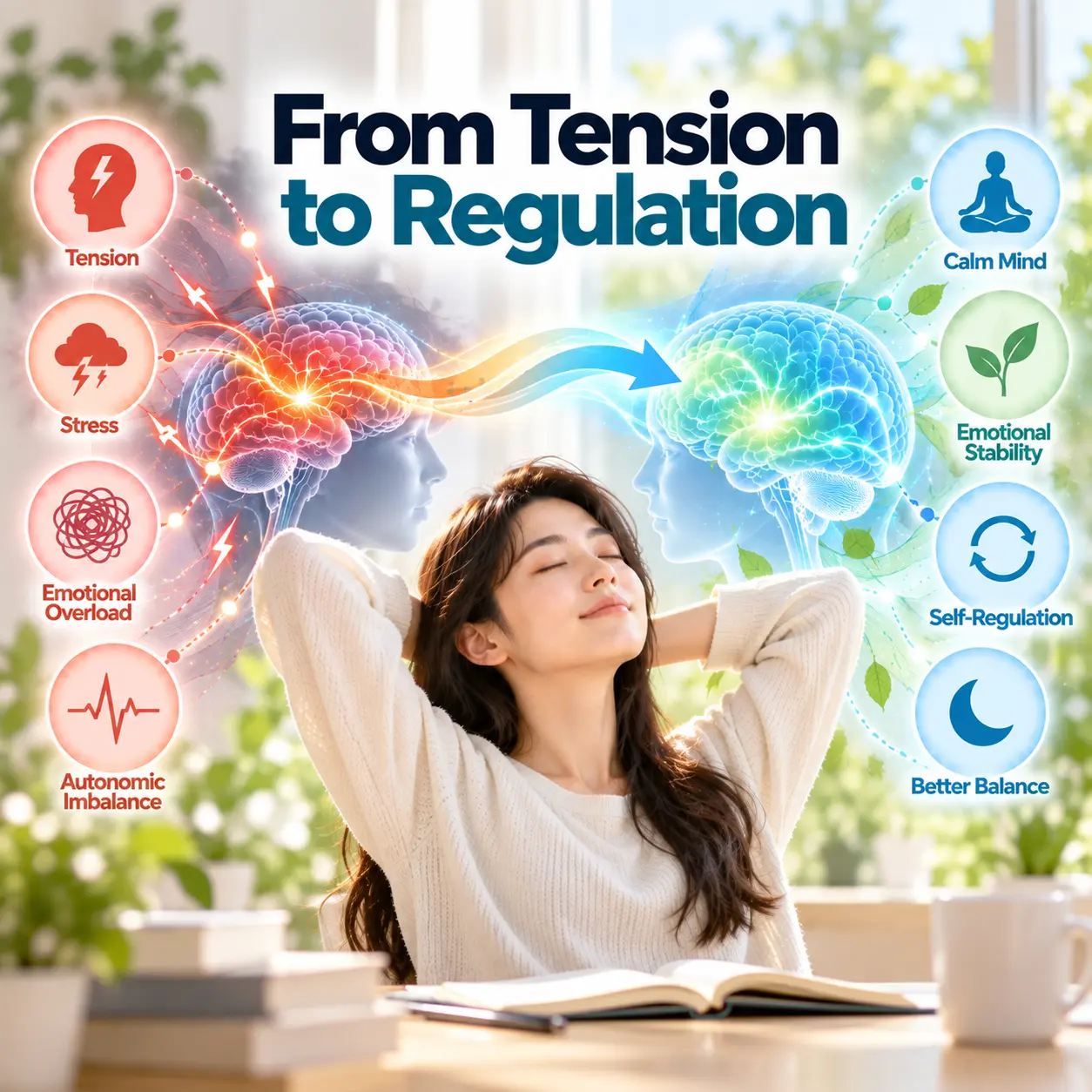
Neuroscience associates emotional and behavioral flexibility with interactions among prefrontal, limbic, and striatal systems. ADHD Korean medicine pathology may use qi stagnation as a functional framework when stress-related emotional tension accompanies attentional or behavioral difficulties. The two explanations should remain conceptually distinct rather than being presented as biologically interchangeable.
Phlegm-Related Disturbance
Phlegm in Korean medicine represents a broader pathological concept than respiratory mucus. In neuropsychiatric pattern differentiation, phlegm-related disturbance may be associated with cognitive clouding, heaviness, reduced mental clarity, or unstable mental activity. When such manifestations accompany attentional difficulties, a phlegm-related pattern may be considered within the overall clinical picture.
Modern neuroscience would instead investigate variables such as attention network efficiency, arousal, sleep quality, cognitive processing, and fronto-striatal function. ADHD Korean medicine pathology uses a systemic pattern framework, whereas neuroscience describes measurable neural and physiological processes. Maintaining this distinction allows both explanatory systems to be discussed without implying false equivalence.
Environmental and Daily-Life Influences
ADHD is understood as a multifactorial neurodevelopmental condition in which genetic susceptibility, neurodevelopment, neurotransmitter regulation, and environmental factors interact. Environmental influences can affect functional impairment and symptom expression, but they should not automatically be interpreted as the primary cause of ADHD.
Sleep disruption, family or occupational stress, irregular daily routines, sustained cognitive demands, and coexisting emotional difficulties may influence attention and behavioral regulation. Sleep is particularly relevant because inadequate or irregular sleep can worsen concentration, emotional reactivity, and executive performance.
From an ADHD Korean medicine pathology perspective, persistent sleep disruption and stress can also influence pattern differentiation. Restlessness with poor sleep may contribute to consideration of yin deficiency, while fatigue and reduced mental endurance may support examination of qi-blood deficiency. Stress accompanied by tension and emotional fluctuation may be examined through qi stagnation.
Treatment Perspective
From the perspective of Korean Medicine Neuropsychiatry, treatment is understood as an individualized process aimed at improving functional regulation while considering attention, behavioral control, emotional state, sleep, autonomic balance, stress response, and Korean medicine pattern differentiation.
Nervous-system regulation is clinically relevant because ADHD involves networks supporting executive function, attention, motivation, and behavioral inhibition. The prefrontal cortex, basal ganglia, striatum, and fronto-striatal circuits provide important neurobiological frameworks for understanding these functions, while dopamine and norepinephrine contribute to the regulation of these networks.
ADHD Korean medicine pathology examines whether an individual’s broader symptom pattern is consistent with concepts such as qi-blood deficiency, yin deficiency, qi stagnation, or phlegm-related disturbance. Pattern differentiation is not intended to redefine ADHD as a personality characteristic or to replace its neurodevelopmental classification.
Autonomic balance provides another relevant dimension. Flexible transitions between activation and recovery support sleep, cognitive performance, emotional regulation, and adaptation to stress. When persistent physiological activation or inadequate recovery accompanies attentional symptoms, sleep patterns, stress exposure, daily rhythm, and emotional regulation may all become relevant to the broader clinical assessment.
Recovery is understood as multidimensional. Meaningful improvement can involve more stable attention, improved behavioral inhibition, better sleep, reduced stress reactivity, improved emotional regulation, and greater consistency in academic, occupational, or everyday functioning.
An Integrated Understanding of ADHD
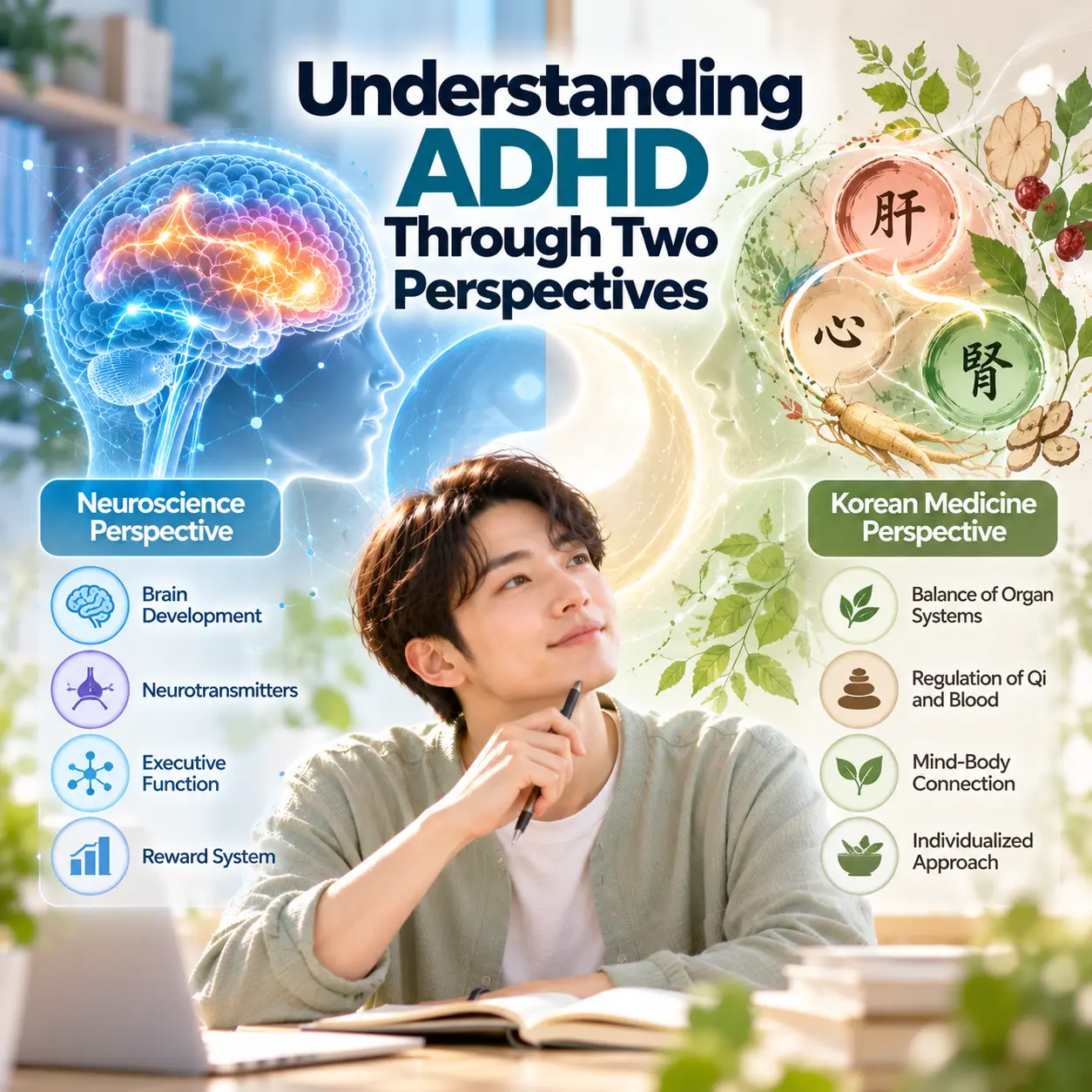
An integrated interpretation is possible when different levels of explanation are clearly distinguished. Neuroscience investigates neural circuits, neurotransmission, developmental processes, autonomic regulation, and stress physiology. Korean medicine investigates functional patterns involving qi, blood, yin, stress-related stagnation, and mind-body regulation.
ADHD Korean medicine pathology is therefore best understood as a Korean medicine framework for organizing the wider pattern of neuropsychiatric and systemic manifestations associated with an individual presentation. It does not mean that qi-blood deficiency is identical to prefrontal dysfunction or that yin deficiency represents a specific neurotransmitter abnormality.
This distinction supports academically precise integration. The neurodevelopmental model can explain mechanisms involving executive function and fronto-striatal regulation, while Korean medicine pattern differentiation can describe relationships among cognitive fatigue, restlessness, sleep, emotional tension, and accompanying physical manifestations.
Summary
ADHD is described as a neurodevelopmental disorder involving persistent difficulties with attention and/or hyperactivity-impulsivity that can produce meaningful functional impairment. Its neural mechanisms are associated with executive function, the prefrontal cortex, basal ganglia, striatum, and fronto-striatal circuits. Dopamine and norepinephrine contribute to attention, motivation, reward processing, and behavioral regulation.
ADHD Korean medicine pathology is understood as a complementary pattern-based framework. Qi-blood deficiency may be associated with fatigue, reduced concentration, and diminished mental endurance. Yin deficiency may be associated with restlessness and difficulty settling. Qi stagnation may be linked conceptually with stress-related emotional and behavioral dysregulation, while phlegm-related disturbance may be considered when cognitive clouding and heaviness occur within the broader pattern.
Stress physiology, autonomic regulation, sleep, and environmental conditions may influence the expression of ADHD symptoms. These variables also provide useful points for examining how neural regulation and Korean medicine pattern differentiation address different dimensions of the same clinical presentation without treating their concepts as direct biological equivalents.
Korean Medicine Neuropsychiatry studies and integrates neurobiological, psychological, physiological, and Korean medicine perspectives to develop structured explanations of ADHD and related neuropsychiatric conditions. The Korean Society of Oriental Neuropsychiatry investigates these relationships as an active academic research body and explains how Korean medicine pattern frameworks can be examined alongside contemporary neuroscience while preserving the conceptual characteristics of each medical system.