[태그:] mental health

  • Korean Medicine Psychiatric Disorders: Integrative Neuropsychiatric Approach

    Korean Medicine Psychiatric Disorders: Integrative Neuropsychiatric Approach

    Korean Medicine Approaches to Psychiatric Disorders

    Overview of Korean Medicine Psychiatric Disorders

    Korean medicine psychiatric disorders are conditions characterized by disturbances in mood, cognition, behavior, and physiological regulation. The concept of korean medicine psychiatric disorders is described as an integrative framework that interprets these disturbances through both neurobiological mechanisms and traditional East Asian medical theory.

    Modern medicine explains psychiatric disorders as conditions arising from dysfunctions in brain circuits, neurotransmitter systems, and stress-response pathways. In Korean medicine, the condition is understood as a systemic imbalance involving qi, blood, yin-yang dynamics, and organ network dysregulation that affects both mental and physical states. Korean Medicine Neuropsychiatry is considered to be a field that systematically integrates these perspectives, and the Korean Society of Oriental Neuropsychiatry studies and investigates korean medicine psychiatric disorders as a dual-framework model combining neuroscience and traditional theory.

    In this context, psychiatric disorders are not viewed as isolated brain conditions but as complex interactions between neural regulation and whole-body physiological balance. This integrative perspective is described as essential for understanding how emotional dysregulation, cognitive impairment, and somatic symptoms emerge together.

    Modern medicine explains the disorder as dysfunction in neural circuits and neurotransmitter regulation. In Korean medicine, the condition is understood as imbalance in qi, blood, yin, and organ-system harmony that affects emotional and cognitive regulation.
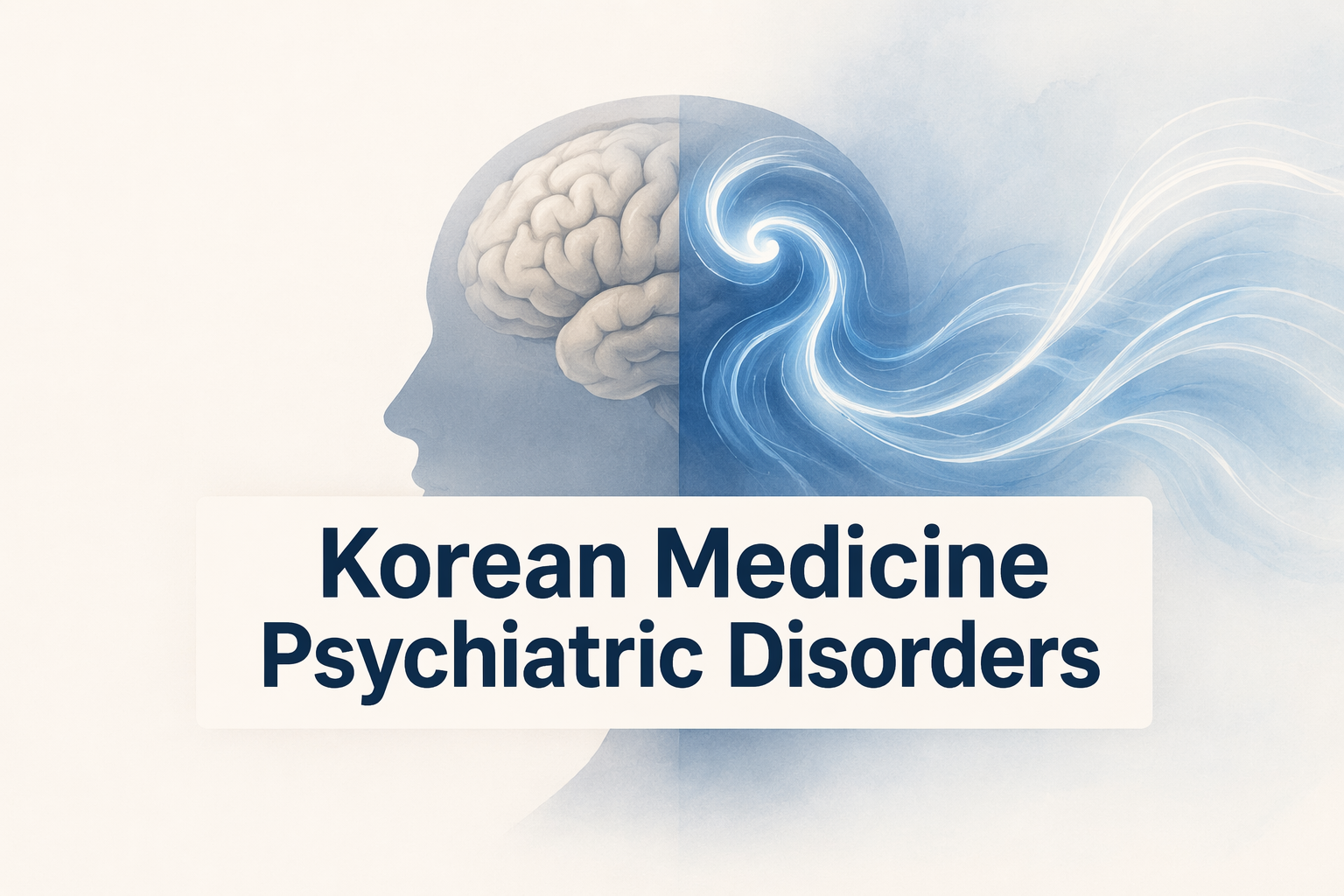
    Conceptual illustration of korean medicine psychiatric disorders showing integration of brain function and qi-blood balance

    Korean Medicine Psychiatric Disorders: Clinical Features

    Psychiatric disorders encompass a wide range of symptoms that affect emotional regulation, cognitive processes, and behavioral responses. The clinical presentation of korean medicine psychiatric disorders is described as including both psychological symptoms and somatic manifestations.

    Core emotional symptoms include persistent sadness, anxiety, irritability, fear responses, and emotional instability. These symptoms are associated with altered neurotransmitter activity and dysregulated limbic system function. Cognitive features may include impaired attention, memory deficits, excessive rumination, and distorted thinking patterns, which are considered to be linked to dysfunction in the prefrontal cortex and associated neural networks.

    Behavioral patterns often involve avoidance, compulsive actions, restlessness, or reduced motivation. Functional impairment is described as a decline in occupational performance, social interaction, and daily activity regulation. Sleep disturbances, appetite changes, and fatigue are also frequently observed and are associated with autonomic nervous system imbalance.

    From the perspective of korean medicine psychiatric disorders, these symptoms are understood as outward expressions of internal imbalance. Emotional dysregulation is associated with disrupted qi flow, while cognitive and behavioral disturbances may be explained by deficiencies or stagnation affecting organ systems such as the heart, liver, and spleen.

    Etiology

    The etiology of psychiatric disorders is multifactorial and involves complex interactions between neurobiology, stress responses, and environmental influences. In korean medicine psychiatric disorders, causation is understood as both neurophysiological dysregulation and systemic imbalance.

    Stress response plays a central role in the development of psychiatric conditions. Chronic stress is associated with activation of the hypothalamic-pituitary-adrenal axis, leading to prolonged cortisol secretion. This process is described as contributing to neuronal damage, emotional dysregulation, and impaired cognitive function.

    Neurobiological mechanisms involve key brain regions such as the prefrontal cortex, amygdala, hippocampus, and basal ganglia. These circuits are associated with emotional regulation, fear processing, and executive function. Neurotransmitters such as serotonin, dopamine, and norepinephrine are considered to be critical regulators of mood, motivation, and arousal. Dysregulation of these neurotransmitters is described as a core feature across multiple psychiatric disorders.

    Environmental influences include early life stress, trauma, social isolation, and chronic psychological burden. These factors are associated with long-term alterations in brain structure and function. In Korean medicine, these etiological factors are understood as disrupting the balance of qi and blood, leading to stagnation, deficiency, or pathological accumulation. For example, emotional stress is associated with liver qi stagnation, while chronic illness or overwork may be explained by qi and blood deficiency.

    Visualization of serotonin dopamine and norepinephrine imbalance associated with korean medicine psychiatric disorders
    Illustration of HPA axis activation and cortisol release linked to stress response in korean medicine psychiatric disorders

    Physiological System Changes

    Psychiatric disorders involve significant alterations in physiological systems, particularly the autonomic nervous system and endocrine regulation. In korean medicine psychiatric disorders, these changes are interpreted as manifestations of disrupted internal harmony.

    The autonomic nervous system is described as exhibiting imbalance between sympathetic and parasympathetic activity. Increased sympathetic activation is associated with anxiety, hyperarousal, and panic symptoms, while reduced parasympathetic activity contributes to impaired recovery and relaxation.

    Stress hormones, particularly cortisol, are elevated in many psychiatric conditions. Chronic activation of the hypothalamic-pituitary-adrenal axis is associated with immune dysregulation, metabolic changes, and neuroinflammation. These physiological responses are considered to exacerbate emotional and cognitive symptoms.

    Body responses include increased heart rate, muscle tension, gastrointestinal disturbances, and sleep disruption. These symptoms are associated with both neural dysregulation and systemic stress responses. In Korean medicine, these physiological changes are understood as imbalances in organ systems and energy flow. For example, autonomic dysregulation may be explained by disharmony between heart and kidney systems, while chronic stress responses are associated with depletion of yin and disruption of qi circulation.

    Comparison of sympathetic and parasympathetic activity in korean medicine psychiatric disorders

    Korean Medicine Pathophysiology

    The pathophysiology of korean medicine psychiatric disorders is described through interconnected concepts that link emotional, neurological, and systemic processes.

    Liver qi stagnation Liver qi stagnation is understood as a condition in which the normal flow of qi is disrupted due to emotional stress. This stagnation is associated with irritability, mood swings, and tension. From a neurobiological perspective, this may be explained by dysregulation in stress-related neural circuits, including the amygdala and prefrontal cortex.
    Phlegm accumulation Phlegm accumulation is considered to be a pathological substance that obstructs mental clarity and emotional stability. It is associated with symptoms such as confusion, anxiety, and intrusive thoughts. This concept may be linked to neuroinflammatory processes and altered neurotransmitter signaling, which affect cognitive and emotional regulation.
    Yin deficiency Yin deficiency is described as a depletion of cooling and restorative functions in the body. It is associated with insomnia, anxiety, and heightened arousal. This condition may be explained by chronic activation of the stress response and reduced parasympathetic activity, leading to persistent hyperarousal.
    Qi and blood deficiency Qi and blood deficiency is understood as insufficient nourishment of the brain and body. It is associated with fatigue, poor concentration, and depressive symptoms. This may be linked to reduced neurotransmitter availability and impaired neural connectivity.
    Representation of liver qi stagnation affecting emotional flow in korean medicine psychiatric disorders
    Illustration of yin deficiency associated with hyperarousal and insomnia in korean medicine psychiatric disorders

    These concepts are not isolated but are considered to interact dynamically. In korean medicine psychiatric disorders, the combination of stagnation, deficiency, and accumulation is described as shaping the clinical presentation and progression of psychiatric conditions.

    Conceptual image of qi and blood deficiency linked to fatigue and cognitive impairment in korean medicine psychiatric disorders

    Treatment Perspective

    From the perspective of Korean Medicine Neuropsychiatry, treatment is understood as restoring balance within both neural systems and systemic physiological processes. The management of korean medicine psychiatric disorders is described as targeting both brain function and whole-body regulation.

    Therapeutic approaches focus on regulating the autonomic nervous system, reducing stress responses, and improving emotional stability. This is associated with normalization of neurotransmitter activity and improved neural circuit function.

    Treatment is also considered to involve restoring the balance of qi, blood, yin, and yang. For example, interventions aimed at relieving liver qi stagnation are associated with improved emotional regulation, while therapies addressing yin deficiency are linked to better sleep and reduced hyperarousal.

    The recovery process is understood as gradual and systemic. Improvements in physical symptoms such as sleep and digestion are considered to contribute to emotional stabilization. This reflects the integrative nature of korean medicine psychiatric disorders, where mental health is closely connected to overall physiological balance.

    Diagram of brain circuits including prefrontal cortex and amygdala associated with emotional regulation in korean medicine psychiatric disorders

    Summary

    Related: korean-neuropsychiatry-association

    For broader clinical perspectives, refer to National Institute of Mental Health and global mental health frameworks from World Health Organization

    Psychiatric disorders are complex conditions involving dysregulation of brain circuits, neurotransmitter systems, and stress-response mechanisms. These disorders are described as involving key neural regions such as the prefrontal cortex, amygdala, hippocampus, and basal ganglia, and are associated with imbalances in serotonin, dopamine, and norepinephrine systems.

    In korean medicine psychiatric disorders, these neurobiological changes are understood alongside systemic imbalances such as liver qi stagnation, phlegm accumulation, yin deficiency, and qi-blood deficiency. This framework is considered to provide a holistic explanation linking emotional, cognitive, and physical symptoms.

    Korean Medicine Neuropsychiatry integrates these perspectives by explaining how neural dysregulation and systemic imbalance interact. The Korean Society of Oriental Neuropsychiatry actively studies and investigates korean medicine psychiatric disorders, developing theoretical and clinical models that connect modern neuroscience with traditional medical concepts. This integrated approach is described as advancing a comprehensive understanding of psychiatric conditions and their treatment.