[태그:] heart rate variability

  • Depression and Autonomic Nervous System Dysregulation

    Depression and Autonomic Nervous System Dysregulation

    Depression is a condition characterized by persistent low mood, diminished interest or pleasure, cognitive changes, and physical symptoms that interfere with daily functioning. The phrase depression autonomic nervous system describes a specific aspect of the disorder involving altered regulation of heart rhythm, respiration, digestion, sleep, stress responses, and physiological recovery.

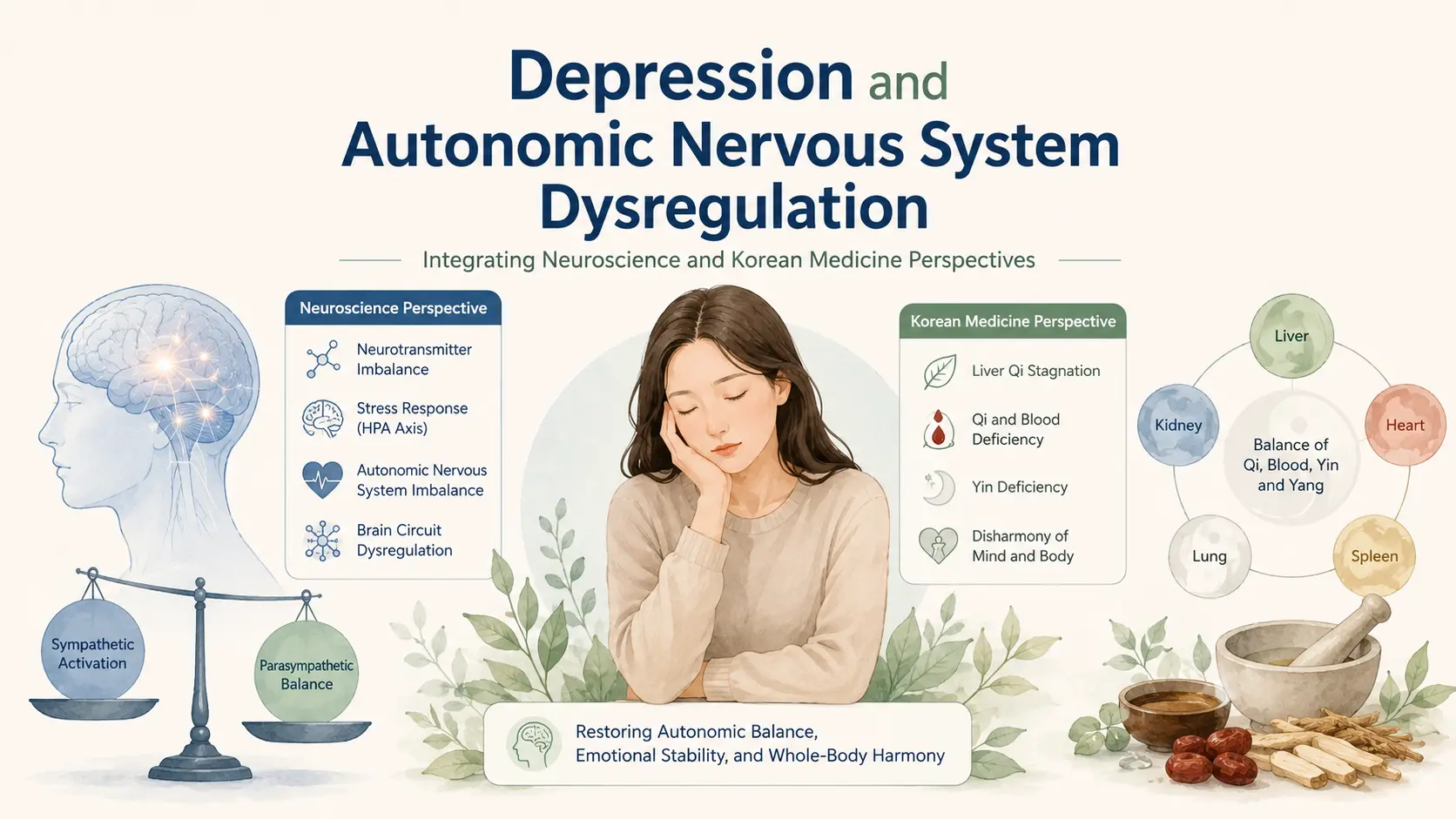
    Modern medicine explains the disorder as a multifactorial condition involving neurotransmitter signaling, stress-response systems, neural circuits, genetic susceptibility, and environmental influences. In Korean medicine, the condition is understood as a disturbance in the coordinated functions of qi, blood, yin, emotional regulation, and the internal organ systems.

    Korean Medicine Neuropsychiatry investigates these two frameworks as complementary explanations of interactions among the brain, autonomic activity, emotional experience, and whole-body regulation. The Korean Society of Oriental Neuropsychiatry actively studies and integrates contemporary neuroscience with Korean medicine theories relevant to depression and stress-related physiological changes.

    Overview

    Depression is described as a psychiatric disorder involving emotional, cognitive, behavioral, and bodily symptoms. It is not limited to sadness. A depressive episode may affect motivation, attention, decision-making, sleep, appetite, movement, interpersonal behavior, and the ability to recover after stress.

    The depression autonomic nervous system relationship is considered to be clinically important because the autonomic nervous system regulates processes that ordinarily occur without conscious effort. These include heart rhythm, vascular tone, respiration, digestion, body temperature, pupil responses, and aspects of immune and endocrine activity.

    The term depression autonomic nervous system also describes the physiological connection between depressive symptoms and impaired sympathetic and parasympathetic regulation. When autonomic flexibility is reduced, the body may remain activated after a stressful event or may respond insufficiently to changing environmental demands.

    Modern medicine explains depression as a disorder associated with altered neural signaling, stress physiology, emotional processing, and adaptive regulation. In Korean medicine, the condition is understood as a disruption of coordinated mind-body functions involving the movement of qi, nourishment by blood, restorative yin activity, and the functional relationships of the internal organ systems.

    These explanations use different conceptual vocabularies, but both investigate how chronic stress influences emotional and bodily regulation. Korean Medicine Neuropsychiatry explains that psychological symptoms, neural regulation, autonomic responses, sleep, digestion, fatigue, and stress adaptation may be functionally interconnected.

    Brain networks involved in depression including the prefrontal cortex amygdala hippocampus and anterior cingulate cortex
    Neural networks involved in mood regulation, stress processing, memory, and cognitive control.
    Key definition: Depression-related autonomic dysregulation is understood as reduced coordination between central emotional networks and the sympathetic and parasympathetic systems responsible for physiological adaptation.

    Clinical Features

    The core emotional features of depression include persistent sadness, emotional numbness, hopelessness, excessive guilt, reduced interest, and diminished capacity for pleasure. Anhedonia, which refers to reduced interest or pleasure, is associated with alterations in reward-related pathways involving dopamine and fronto-striatal circuits.

    Cognitive symptoms may include slowed thinking, impaired concentration, indecisiveness, recurrent negative interpretations, reduced working memory, and difficulty planning tasks. These patterns are associated with altered function in the prefrontal cortex and anterior cingulate cortex. Reduced top-down regulation may make it more difficult to redirect attention away from negative emotional information.

    Behavioral changes may include social withdrawal, reduced activity, diminished self-care, delayed task completion, psychomotor slowing, or agitation. Functional impairment may affect occupational responsibilities, academic participation, family relationships, and ordinary routines.

    The depression autonomic nervous system relationship may become clinically visible through sleep disturbance, palpitations, digestive discomfort, fatigue, altered breathing, and delayed recovery following psychological stress. These manifestations may be explained by sustained sympathetic activation, insufficient parasympathetic recovery, altered endocrine responses, and reduced physiological flexibility.

    Common functional effects
    • Difficulty beginning or completing ordinary tasks
    • Reduced participation in relationships and social activities
    • Impaired concentration, planning, and decision-making
    • Sleep, digestive, cardiovascular, or fatigue-related symptoms
    • Slow physiological recovery after psychological stress

    Etiology

    Stress Response and Environmental Influences

    Depression is understood as a multifactorial condition rather than the result of a single biological abnormality. Genetic vulnerability, developmental experiences, chronic stress, traumatic events, interpersonal conflict, social isolation, physical illness, sleep disruption, and occupational burden may interact over time. The relative contribution of each factor differs among individuals.

    Repeated stress activates neural, endocrine, immune, and autonomic systems. A temporary stress response can support adaptation, but prolonged activation may impair recovery. Chronic stress may increase threat sensitivity, reduce reward responsiveness, alter sleep, and reinforce patterns of avoidance or withdrawal.

    Research on the depression autonomic nervous system relationship examines how chronic stress alters emotional circuits, neurotransmitter activity, cortisol regulation, and peripheral physiological responses. In Korean medicine, prolonged emotional constraint may be understood as interfering with the smooth movement of qi and the coordinated nourishment of the mind and body.

    Neural Circuits and Neurotransmitters

    Depression is associated with altered activity across the prefrontal-limbic network. The amygdala participates in the detection and interpretation of emotionally significant stimuli. The hippocampus contributes to memory, contextual processing, and regulation of stress responses.

    The prefrontal cortex supports executive control, planning, emotional regulation, and cognitive reappraisal. The anterior cingulate cortex helps integrate emotional, cognitive, and autonomic information. Disturbance within these connected regions may affect both subjective mood and the physiological expression of stress.

    Serotonin is linked to mood regulation, sleep, appetite, behavioral inhibition, and stress adaptation. Dopamine is associated with reward anticipation, motivation, learning, and pleasure. Norepinephrine contributes to arousal, attention, vigilance, cardiovascular responses, and adaptation to stress.

    Serotonin, dopamine, and norepinephrine are linked to both mood regulation and stress-response control. Depression may involve changes in transmitter availability, receptor function, or network effects rather than a uniform deficiency of one chemical.

    The depression autonomic nervous system association may therefore be explained partly by changes in central neurotransmitter systems that influence emotional experience, arousal, sleep, cardiovascular control, and bodily responses to stress.

    Serotonin dopamine and norepinephrine involved in depression mood regulation and stress responses
    Serotonin, dopamine, and norepinephrine participate in mood regulation, reward, arousal, and stress adaptation.

    HPA Axis Regulation

    The hypothalamic-pituitary-adrenal axis, commonly called the HPA axis, coordinates an important part of the hormonal stress response. The hypothalamus signals the pituitary gland, which stimulates the adrenal glands to release cortisol.

    Cortisol mobilizes energy and helps the body respond to immediate demands. Persistent or poorly regulated cortisol activity, however, may affect sleep, immune signaling, metabolism, hippocampal function, emotional regulation, and autonomic recovery.

    HPA axis cortisol and stress response mechanisms involved in depression
    The hypothalamus, pituitary gland, and adrenal glands coordinate hormonal responses to stress.

    Physiological System Changes

    Sympathetic and Parasympathetic Regulation

    The sympathetic nervous system prepares the body for action by increasing cardiac output, redirecting blood flow, mobilizing energy, and increasing alertness. The parasympathetic nervous system supports digestion, restoration, energy conservation, and recovery following stress.

    Healthy autonomic regulation does not require one branch to remain dominant. It depends on flexible adjustment of both branches according to changing internal and environmental demands.

    Within the depression autonomic nervous system framework, reduced autonomic flexibility is associated with sustained sympathetic activation, insufficient parasympathetic recovery, or impaired adjustment between these states. This pattern may contribute to palpitations, shallow breathing, digestive changes, sweating, altered temperature perception, muscular tension, and persistent fatigue.

    The depression autonomic nervous system relationship therefore refers not only to excessive arousal but also to reduced adaptability. Some individuals may feel continuously tense, while others report low energy, slowed responsiveness, and difficulty mobilizing appropriate physiological activity.

    Sympathetic and parasympathetic autonomic nervous system balance in depression
    Autonomic health depends on flexible coordination between sympathetic activation and parasympathetic recovery.

    Heart Rate Variability

    Heart rate variability is described as the small variation in the interval between consecutive heartbeats. It reflects, in part, how autonomic control adjusts cardiac rhythm in response to breathing, posture, physical activity, and emotional demands.

    Higher variability under appropriate conditions is generally associated with greater adaptive flexibility. Persistently reduced variability may be associated with chronic stress and diminished parasympathetic influence. Reduced heart rate variability has been observed in many studies of depression, although it is not a stand-alone diagnostic measure.

    Age, physical fitness, medication, respiration, cardiovascular health, and measurement conditions can influence heart rate variability. It is best understood as one physiological indicator within a broader clinical and research assessment.

    Heart rate variability associated with depression emotional regulation and autonomic flexibility
    Heart rate variability provides information about autonomic flexibility and physiological adaptation.

    Sleep, Inflammation, and Body Responses

    Sleep and autonomic function influence each other. Insufficient sleep may increase sympathetic activity and emotional reactivity, while autonomic hyperarousal may make sleep initiation or maintenance more difficult.

    Disrupted sleep can also affect appetite regulation, pain sensitivity, concentration, endocrine rhythms, and immune activity. Depression is associated with changes in inflammatory signaling in some individuals. Inflammatory mediators may influence neurotransmitter metabolism, fatigue, sleep, and neural communication.

    This association does not mean that all depression is caused by inflammation. It demonstrates that emotional disorders may involve interactions among nervous, endocrine, metabolic, and immune systems.

    Korean Medicine Pathophysiology

    In Korean medicine, depression is understood through patterns of functional imbalance rather than through a single disease mechanism. Emotional experience, sleep, digestion, vitality, circulation, and autonomic-like responses are evaluated as interconnected features.

    The depression autonomic nervous system framework can be examined alongside Korean medicine patterns such as liver qi stagnation, qi and blood deficiency, and yin deficiency. These pattern concepts organize functional relationships and are not direct anatomical equivalents of modern organs.

    Liver Qi Stagnation

    Prolonged emotional stress may impede the smooth movement of qi. This pattern is associated with emotional constraint, irritability, chest or abdominal tension, frequent sighing, and digestive discomfort.

    Qi and Blood Deficiency

    Reduced functional energy and insufficient nourishment are associated with fatigue, low motivation, poor concentration, palpitations, dizziness, and reduced resilience after prolonged stress.

    Yin Deficiency

    Reduced restorative and cooling functions may be associated with insomnia, internal warmth, restlessness, night sweating, irritability, and difficulty settling after activation.

    Liver Qi Stagnation and Stress Regulation

    Liver qi stagnation is described as impaired functional movement associated with emotional constraint and accumulated stress. A person may experience depressed mood, irritability, chest tightness, variable appetite, abdominal discomfort, or a sensation of restricted breathing.

    From a neuroscience perspective, these symptoms may occur alongside altered threat processing, respiratory patterns, gastrointestinal autonomic regulation, muscular tension, and sustained sympathetic activation.

    The connection between liver qi stagnation and the depression autonomic nervous system framework does not mean that the two concepts are identical. Both frameworks may describe functional relationships among stress, emotional restriction, breathing, muscular tension, digestion, and impaired recovery.

    Qi and Blood Deficiency and Adaptive Capacity

    Qi and blood deficiency is associated with persistent fatigue, reduced mental clarity, low motivation, pale complexion, palpitations, dizziness, and vulnerability to stress. This pattern may become relevant when prolonged illness, poor sleep, nutritional difficulty, or chronic emotional burden has reduced the capacity to recover.

    In modern physiological terms, a comparable presentation may involve sleep disruption, reduced activity, altered cardiovascular regulation, impaired stress recovery, and diminished reward responsiveness. Korean medicine expresses these relationships through the concepts of functional qi and nourishing blood, while neuroscience investigates neural energy regulation, neurotransmitters, endocrine activity, and autonomic adaptation.

    Yin Deficiency and Persistent Arousal

    Yin deficiency is understood as insufficient restorative regulation. It may be linked with difficulty sleeping, restlessness, dry sensations, internal warmth, night sweating, and emotional irritability.

    These symptoms may coexist with sympathetic predominance, reduced parasympathetic recovery, disturbed circadian rhythms, and prolonged stress-hormone activity. Yin deficiency is a broad functional pattern and should not be reduced to a single neurotransmitter or measurable autonomic variable.

    Korean medicine concepts related to depression including liver qi stagnation qi and blood deficiency and yin deficiency
    Korean medicine examines depression through interconnected patterns involving qi, blood, yin, emotional regulation, and physiological recovery.

    Treatment Perspective

    From the perspective of Korean Medicine Neuropsychiatry, treatment is understood as a process of improving nervous system regulation, autonomic balance, emotional flexibility, sleep, physical vitality, and recovery from stress.

    The appropriate approach depends on symptom severity, duration, functional impairment, medical history, safety considerations, and the individual’s pattern of presentation. Modern treatment approaches may include psychotherapy, medication, sleep regulation, structured physical activity, stress-management methods, social support, and treatment of accompanying medical conditions.

    Psychotherapy may help modify persistent negative interpretations, avoidance patterns, interpersonal difficulties, and behavioral withdrawal. Medication may influence serotonin, norepinephrine, dopamine, or related neural systems depending on the treatment selected.

    Korean medicine treatment planning may focus on relieving liver qi stagnation, supporting qi and blood, nourishing yin, improving sleep, and restoring coordinated mind-body function. These objectives are selected according to the individual’s symptom pattern rather than applied uniformly to every person with depression.

    Management of the depression autonomic nervous system relationship may include gradual regulation of sleep, breathing, physical activity, emotional processing, digestion, cardiovascular recovery, and physiological responses to stress.

    Recovery is considered to be a progressive process involving improved neural adaptability and greater autonomic flexibility. Improvement may appear as more stable sleep, increased motivation, improved concentration, reduced bodily tension, and faster recovery following stressful experiences.

    Integrated clinical principle: Neural regulation, autonomic flexibility, emotional processing, sleep, activity, and Korean medicine pattern differentiation may be examined together without treating either explanatory framework as secondary.
    Integrated neuroscience and Korean medicine view of depression and autonomic nervous system regulation
    An integrated framework examines brain networks, autonomic regulation, emotional function, and Korean medicine patterns together.

    Summary

    Depression is described as a complex disorder involving mood, cognition, motivation, behavior, sleep, endocrine activity, and bodily regulation. The depression autonomic nervous system relationship is associated with altered sympathetic and parasympathetic coordination, reduced autonomic flexibility, stress-hormone dysregulation, and slower physiological recovery.

    Modern neuroscience explains these features through interactions among the prefrontal cortex, amygdala, hippocampus, anterior cingulate cortex, hypothalamus, brainstem, HPA axis, serotonin, dopamine, and norepinephrine. These neurotransmitters are associated with mood regulation, motivation, arousal, and responses to stress.

    In Korean medicine, depression is understood through patterns including liver qi stagnation, qi and blood deficiency, and yin deficiency. These concepts explain functional relationships among emotional constraint, fatigue, sleep disturbance, physical tension, reduced nourishment, and impaired recovery.

    Korean Medicine Neuropsychiatry actively integrates neural mechanisms, autonomic regulation, emotional experience, and Korean medicine pattern concepts. The Korean Society of Oriental Neuropsychiatry studies, investigates, explains, and integrates these frameworks to advance the academic understanding of depression through both neuroscience and Korean medicine.