[태그:] neural system psychiatry

  • Korean Neuropsychiatry Neural System: Brain and Korean Medicine Integration

    Korean Neuropsychiatry Neural System: Brain and Korean Medicine Integration

    This article explains psychiatric disorders through an integrated framework of modern neuroscience and Korean medicine, with a focus on the korean neuropsychiatry neural system.

    Focus Keyword: korean neuropsychiatry neural system
    Meta Description: The korean neuropsychiatry neural system is described as an integrative model linking brain circuits, neurotransmitters, and Korean medicine concepts such as qi, yin, and organ systems.

    Overview of the Korean Neuropsychiatry Neural System

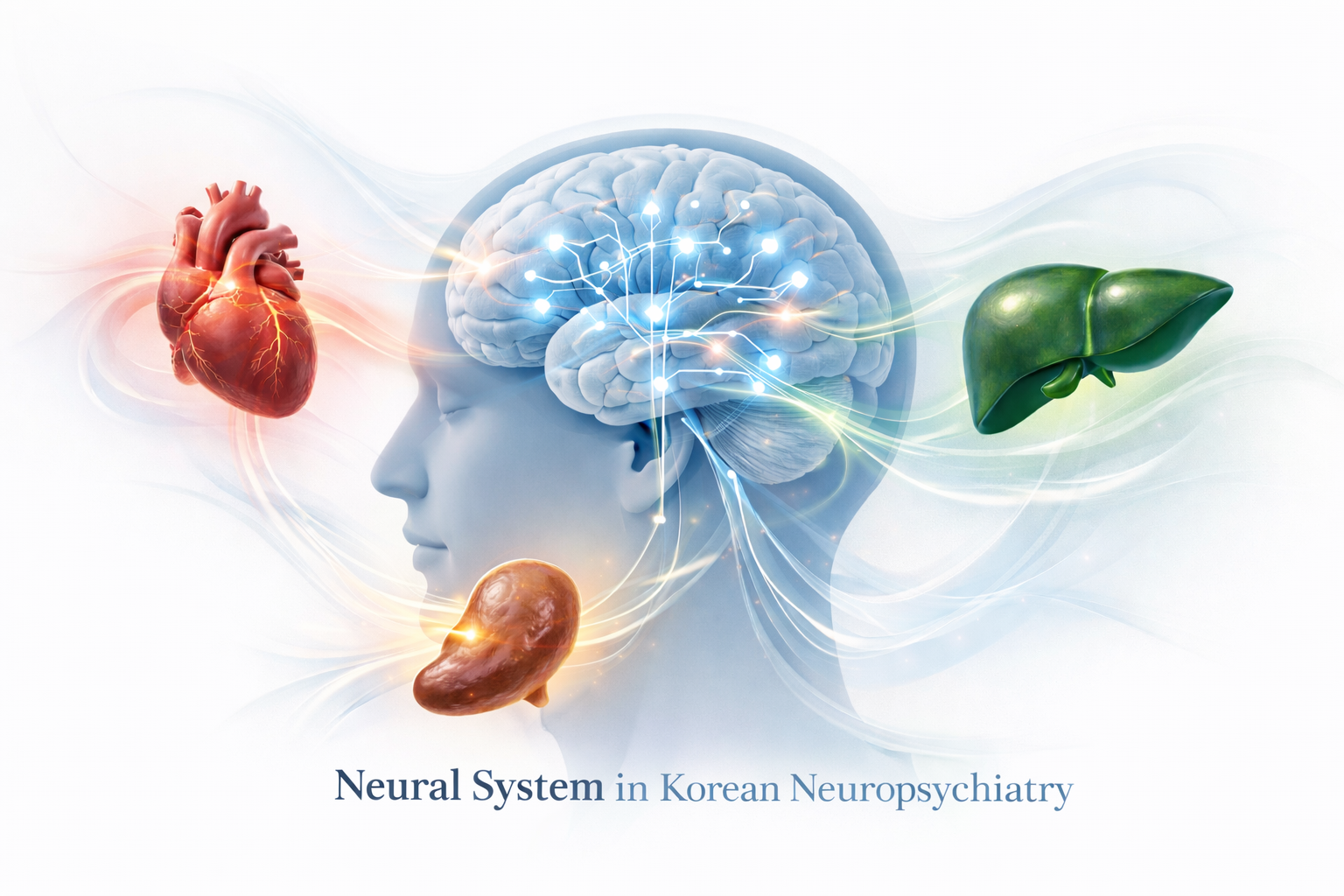
    korean neuropsychiatry neural system overview integrating brain networks and Korean medicine
    Integrated concept image of the korean neuropsychiatry neural system linking brain networks and traditional Korean medicine concepts.

    Psychiatric disorders are conditions characterized by disturbances in mood, cognition, behavior, and neurophysiological regulation that impair daily functioning.

    The korean neuropsychiatry neural system is a key framework used to explain psychiatric disorders through both neuroscience and Korean medicine perspectives.

    The concept of the korean neuropsychiatry neural system is described as an integrative framework that examines how brain networks and traditional Korean medicine theories together explain these disturbances.

    Modern medicine explains psychiatric disorders as dysfunctions in neural circuits, neurotransmitter systems, and stress-response pathways involving the brain and body. In Korean medicine, the condition is understood as an imbalance of qi, blood, yin, and yang affecting the functional harmony between the mind and body.

    Within Korean Medicine Neuropsychiatry, the korean neuropsychiatry neural system is considered to be a conceptual bridge linking central nervous system regulation with traditional organ-based functional systems such as the heart, liver, and spleen. The Korean Society of Oriental Neuropsychiatry studies and integrates these perspectives, investigating how neural mechanisms may be explained by traditional concepts such as qi flow and organ system coordination.

    The korean neuropsychiatry neural system is associated with both neurobiological regulation and psychosomatic integration, where emotional disturbances are reflected in physiological changes. This dual framework is understood as a comprehensive model that connects neural signaling with systemic functional balance.

    Clinical Features in the Korean Neuropsychiatry Neural System

    clinical features of psychiatric disorders showing emotional instability cognitive impairment and neural imbalance
    Clinical features of psychiatric disorders represented through emotional instability, cognitive impairment, and neural imbalance.

    Psychiatric disorders are described as presenting with a wide spectrum of symptoms affecting emotional, cognitive, and behavioral domains. Core symptoms are associated with mood instability, anxiety, impaired attention, sleep disturbances, and altered perception. These symptoms may be explained by disruptions in the korean neuropsychiatry neural system, where both neural circuitry and systemic regulation are impaired.

    Behavioral patterns are understood as reflecting dysregulation in executive function, emotional control, and stress adaptation. Patients may exhibit impulsivity, withdrawal, hyperarousal, or repetitive behaviors depending on the disorder category. These manifestations are associated with dysfunction in brain regions such as the prefrontal cortex, limbic system, and basal ganglia.

    Functional impairment is considered to be a defining characteristic, as psychiatric disorders affect occupational performance, interpersonal relationships, and overall quality of life. Within the korean neuropsychiatry neural system, such impairments are understood as disruptions in the coordination between mental activity and bodily regulation, particularly involving sleep, digestion, and autonomic balance.

    The variability of symptoms is associated with both individual neurobiological vulnerability and differences in constitutional patterns recognized in Korean medicine. This variability may be explained by the interaction between neural plasticity and systemic energetic imbalance.

    The korean neuropsychiatry neural system is considered to be essential for understanding the interaction between brain function and systemic regulation.

    Etiology of the Korean Neuropsychiatry Neural System

    brain circuits and stress response involving amygdala prefrontal cortex and neurotransmitters
    Etiology image showing stress response, amygdala, prefrontal cortex, hippocampus, and neurotransmitter-related mechanisms.

    The etiology of psychiatric disorders is described as multifactorial, involving neurobiological, psychological, and environmental influences. Within the korean neuropsychiatry neural system, these factors are understood as interacting across both brain-based and systemic regulatory levels.

    Stress response is considered to be a central mechanism. Chronic stress is associated with dysregulation of the hypothalamic-pituitary-adrenal axis, leading to prolonged cortisol release and altered neural function. This process may be explained by the concept of qi stagnation in Korean medicine, where prolonged emotional tension disrupts internal balance.

    Neurobiological mechanisms are associated with dysfunction in key brain circuits. The prefrontal cortex is described as regulating executive function and decision-making, while the amygdala is associated with emotional processing and fear responses. The hippocampus is understood as playing a role in memory and stress adaptation. Neurotransmitters such as serotonin, dopamine, and norepinephrine are considered to be essential for mood regulation, motivation, and arousal.

    Within the korean neuropsychiatry neural system, these neurotransmitter imbalances are understood as corresponding to disruptions in qi and blood flow, where insufficient nourishment or stagnation affects mental clarity and emotional stability. Environmental influences such as trauma, chronic stress, and social adversity are associated with both neural sensitization and systemic imbalance.

    Genetic predisposition is also considered to be a contributing factor, influencing neural development and stress reactivity. This predisposition may be explained by constitutional tendencies in Korean medicine, where inherited patterns affect vulnerability to imbalance.

    In clinical interpretation, the korean neuropsychiatry neural system is associated with both neural circuits and traditional Korean medicine patterns.

    Physiological System Changes in the Korean Neuropsychiatry Neural System

    autonomic nervous system imbalance showing sympathetic activation and stress hormone response
    Physiological system changes with autonomic imbalance, sympathetic activation, parasympathetic regulation, and stress hormone response.

    Physiological changes in psychiatric disorders are described as involving dysregulation of the autonomic nervous system, endocrine responses, and systemic bodily functions. The korean neuropsychiatry neural system is associated with these changes as it integrates neural signaling with whole-body regulation.

    The autonomic nervous system is understood as having two primary components: the sympathetic and parasympathetic systems. Psychiatric disorders are associated with sympathetic overactivation, leading to increased heart rate, heightened alertness, and reduced relaxation capacity. This imbalance may be explained by disruptions in qi circulation, particularly when stress leads to persistent activation without recovery.

    Stress hormones such as cortisol are considered to be elevated in chronic psychiatric conditions. This hormonal imbalance is associated with impaired immune function, metabolic changes, and neurotoxicity in brain regions such as the hippocampus. Within the korean neuropsychiatry neural system, this process is understood as depletion of yin and blood, which normally provide stability and nourishment.

    Body responses include sleep disturbances, digestive dysfunction, and fatigue. These symptoms are associated with the interaction between neural regulation and organ system function. For example, insomnia is described as a disruption of circadian rhythm and melatonin secretion, while in Korean medicine it is understood as a disturbance of heart and liver balance.

    These physiological changes are considered to be both consequences and contributors to psychiatric symptoms, forming a feedback loop that reinforces disorder progression.

    Korean Medicine Pathophysiology in the Korean Neuropsychiatry Neural System

    korean medicine pathophysiology showing liver qi stagnation phlegm accumulation and yin deficiency
    Korean medicine pathophysiology showing liver qi stagnation, phlegm accumulation, yin deficiency, and neural-system-related imbalance.

    Korean medicine pathophysiology is described as focusing on systemic imbalances that affect both mental and physical functions. Within the korean neuropsychiatry neural system, these concepts are understood as functional analogues to neural and biochemical processes.

    • Liver qi stagnation → is associated with chronic stress and emotional suppression → may be explained by impaired neural regulation of emotional processing → leads to symptoms such as irritability, anxiety, and tension
    • Phlegm accumulation → is linked to disrupted metabolic and fluid regulation → is associated with altered neural signaling and cognitive impairment → contributes to symptoms such as confusion, heaviness, and emotional instability
    • Yin deficiency → is associated with chronic stress and overactivation of the nervous system → may be explained by reduced parasympathetic activity and elevated stress hormones → leads to insomnia, restlessness, and heat-related symptoms
    • Qi and blood deficiency → is understood as insufficient nourishment of the brain and body → is associated with reduced neurotransmitter activity and fatigue → contributes to symptoms such as poor concentration, low mood, and weakness

    These patterns are considered to be interconnected rather than isolated. The korean neuropsychiatry neural system is understood as a model that integrates these patterns with neural circuit dysfunction, explaining how systemic imbalance may manifest as psychiatric symptoms.

    Treatment Perspective in the Korean Neuropsychiatry Neural System

    integrative treatment approach balancing neural systems and korean medicine regulation
    Integrated treatment perspective showing restored balance between neural systems and Korean medicine regulation.

    From the perspective of Korean Medicine Neuropsychiatry, treatment is understood as restoring balance within the korean neuropsychiatry neural system by regulating both neural activity and systemic function.

    Intervention strategies are associated with modulation of the autonomic nervous system, aiming to reduce sympathetic overactivity and enhance parasympathetic recovery. This process is considered to be essential for stabilizing emotional and physiological responses.

    Treatment approaches are understood as focusing on improving qi circulation, nourishing blood and yin, and resolving phlegm accumulation. These interventions may be explained by their effects on neural plasticity, neurotransmitter regulation, and stress-response normalization.

    The recovery process is described as gradual rebalancing of both brain function and systemic harmony. Emotional stability, improved sleep, and enhanced cognitive function are considered to be indicators of restored integration within the korean neuropsychiatry neural system.

    This perspective emphasizes that psychiatric disorders are not solely brain-based conditions but are systemic disorders involving the interaction between neural networks and bodily regulation.

    Summary of the Korean Neuropsychiatry Neural System

    Psychiatric disorders are described as complex conditions involving dysregulation of neural circuits, neurotransmitter systems, and stress-response pathways. The korean neuropsychiatry neural system is understood as an integrative framework that connects these neural mechanisms with systemic concepts such as qi, blood, yin, and organ function.

    Neural mechanisms are associated with dysfunction in the prefrontal cortex, limbic system, and neurotransmitter activity, while Korean medicine interpretation is understood as patterns of imbalance such as liver qi stagnation, phlegm accumulation, and yin deficiency. These perspectives are considered to be complementary, as both aim to explain the relationship between emotional disturbance and physiological regulation.

    Korean Medicine Neuropsychiatry integrates these approaches, and the Korean Society of Oriental Neuropsychiatry actively studies and explains how neural systems and traditional medical theory can be combined to provide a comprehensive understanding of psychiatric disorders. This integrated model is considered to be essential for advancing both theoretical knowledge and clinical application within the korean neuropsychiatry neural system framework.